Eta Carinae Nearly Blew Itself Apart in the 1840s. From the Tip of Texas, You Can Just About See It
For a few years in the 1840s an obscure southern star became the second brightest in the night sky. It survived, wrapped itself in a glowing hourglass of gas, and is still one of the most extreme stars known. We worked out how high it gets across Texas.
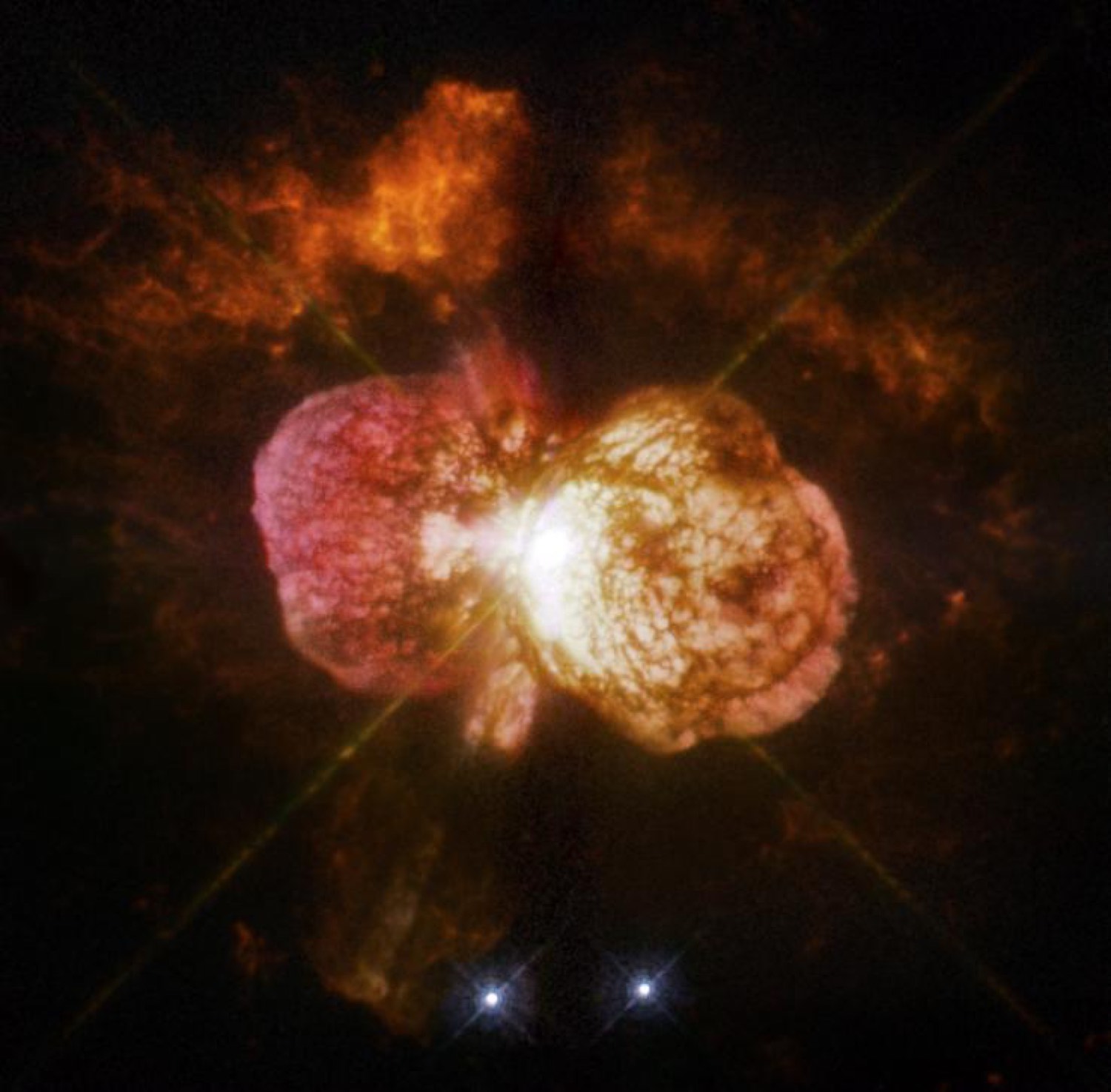
The Homunculus Nebula around Eta Carinae, imaged by the Hubble Space Telescope. The two lobes were blown out during the Great Eruption of the 1840s.
Image: NASA, ESA and the Hubble SM4 ERO Team (public domain)
In the late 1830s, the astronomer John Herschel was at the Cape of Good Hope mapping the southern sky when a modest star in the constellation Carina began to brighten. Over the next several years it kept going. By around 1843 Eta Carinae had become the second brightest star in the whole night sky, outshone only by Sirius.
Then it faded, eventually dropping below naked-eye visibility for decades. It hadn't died. It had nearly torn itself apart and survived.
The Great Eruption
What happened in those years is now called the Great Eruption. The star threw off an enormous amount of material, by many estimates more than ten times the mass of our Sun, in a burst that lasted years. That gas cooled into dust and formed the hourglass-shaped cloud in the Hubble image above, known as the Homunculus Nebula, the "little man." The dust is what dimmed the star for so long.
Events like this are sometimes called supernova impostors. They look, from far away, like a star exploding. Afterwards, the star is still there.
What sits inside
Eta Carinae is at least two stars. The main one is one of the most massive and luminous stars known in our galaxy, millions of times brighter than the Sun. A companion swings around it every five and a half years on a stretched-out orbit. When the two get closest, their fierce winds slam into each other, and astronomers watch the X-ray, radio and visible-light signals change. The last close passage was in 2025. The next is due around 2031.
The system sits about 7,500 light-years away, inside the vast Carina Nebula, one of the brightest star-forming regions in the sky. It will very likely end in a supernova. Nobody can say when, and "soon" in astronomy can mean a hundred thousand years.
For a few years in the 1840s, a star nobody had paid much attention to was the second brightest in the sky. People alive then could see it. Then it vanished behind its own dust.
Can you see it from Texas?
Barely, and only from the far south. Eta Carinae is about 60 degrees south of the celestial equator, so it never rises north of about 30 degrees north. Here is how high it gets at its best, worked out for a few places:
| Location | Highest point |
|---|---|
| Brownsville, Texas | 4.4° |
| Corpus Christi, Texas | 2.6° |
| San Antonio, Texas | about 1°, effectively not visible |
| Miami, Florida | 4.6° |
| Honolulu, Hawaii | 9° |
| Delhi, India | about 2° |
Four degrees is less than half a fist held at arm's length. From the lower Rio Grande Valley or South Padre Island, with a clean, flat southern horizon over open land or the Gulf, you have a real chance. Look in late April and early May, when it's due south around 10 to 11 p.m. from Brownsville. In February and March it gets there later at night.
From the Southern Hemisphere
If you live in Australia, New Zealand, South Africa, Chile, Argentina or southern Brazil, ignore every caveat above. Eta Carinae is high and easy, and the Carina Nebula around it is a showpiece in binoculars. A small telescope at moderate power shows the Homunculus as a tiny orange blob around the star. That blob is gas blown off in the 1840s, still expanding.
There aren't many places where you can look at a star and know it was briefly the second brightest in the sky within the last two centuries. This is one of them.
Sources and further reading
- Altitudes and transit times computed with PyEphem for each city
- Davidson, K. & Humphreys, R. M. (eds.), Eta Carinae and the Supernova Impostors (Springer)
- NASA Hubble, Eta Carinae image releases
Calculated times assume the locations named in the story and can shift slightly elsewhere. Found a mistake? Send a correction.