Meet the Micromoon: July 2027's Full Moon Is the Year's Smallest, and You Can Prove It
Supermoons get the headlines. Their opposite, the full Moon at its farthest, gets none. Here's a six-month photo project that shows the difference with your own camera.
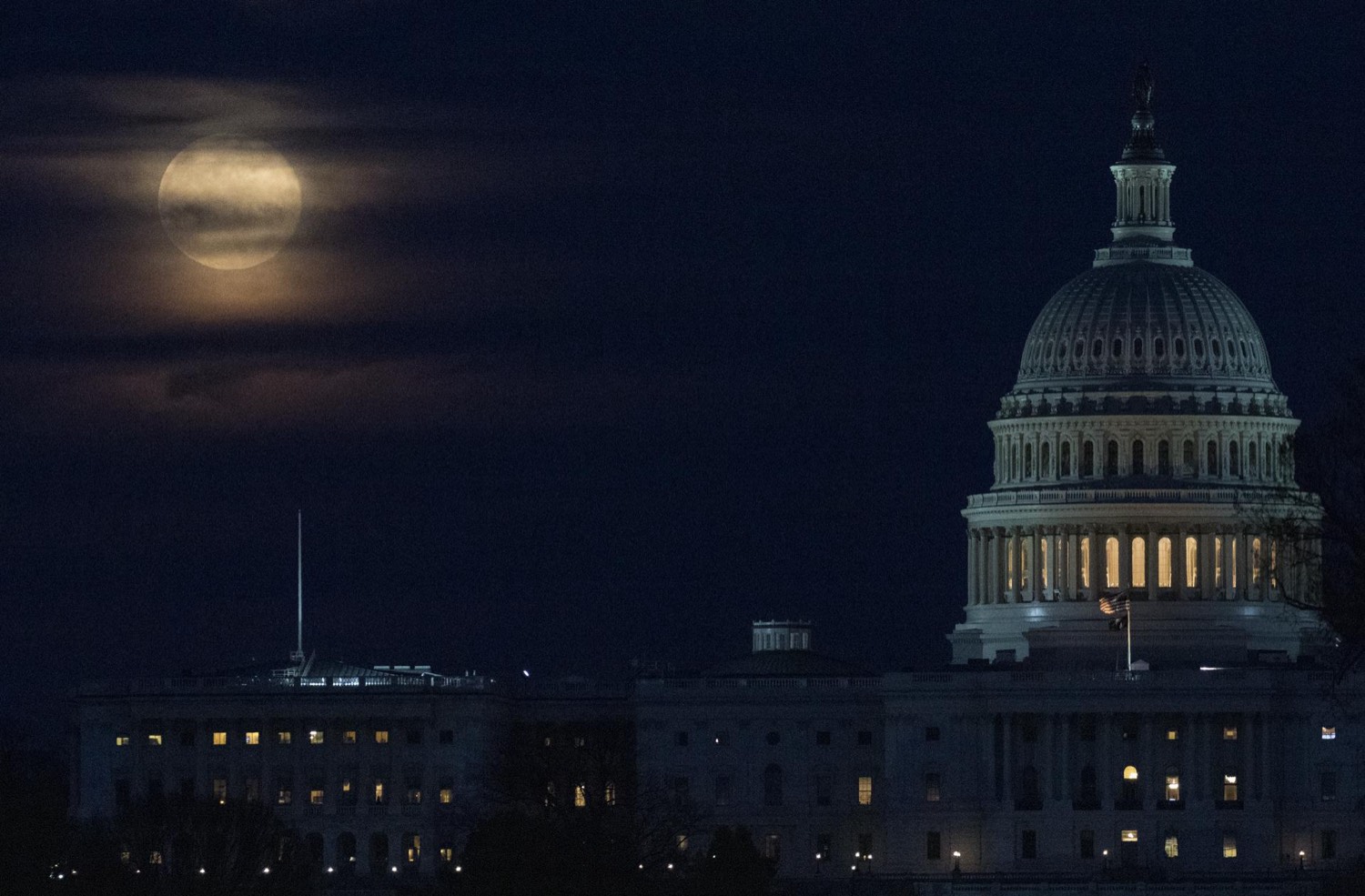
A full Moon near perigee rises behind the U.S. Capitol in Washington, D.C., on March 9, 2020. On July 18, 2027 the full Moon will be at the other extreme.
Photo: NASA/Joel Kowsky (public domain)
The Moon doesn't circle us at a fixed distance. Its orbit is an ellipse, and over each month it swings between about 356,000 and 407,000 kilometers away. When a full Moon happens near the close point, it's called a supermoon. When it happens near the far point, it's sometimes called a micromoon, which is a much less exciting word for the same kind of event.
2027 gives us a tidy pair to compare.
The two extremes of 2027
We computed the distance of every full Moon in 2027. Two stand out:
| Full Moon | Time (UTC) | Distance |
|---|---|---|
| January 22, 2027 | 12:17 | about 357,600 km |
| July 18, 2027 | 15:45 | about 406,000 km |
That's a difference of nearly 48,000 kilometers, almost four Earths laid side by side. In angle, January's Moon looks about 13.5 percent wider than July's. Because brightness depends on the area of the disk, it also sends roughly 29 percent more light our way.
Why you probably won't notice
Thirteen percent sounds like a lot. In the sky, it isn't. The full Moon is only about half a degree across, the width of a pea held at arm's length. A change of a few hundredths of a degree is far below what most people can judge from memory, especially months apart.
The "supermoon" label itself didn't come from astronomy. An astrologer, Richard Nolle, coined it in 1979. Astronomers prefer the term "perigee full Moon." The name stuck because it's catchy, and to be fair it has got a lot of people outside to look at the Moon, which is no bad thing.
What fools people far more is the Moon illusion, the sense that a Moon near the horizon is enormous. That's in your head, not the sky, and we've written about it separately.
The six-month photo experiment
You can see the difference, though, if you let a camera do the remembering.
- Pick one setup and stick with it. Same camera, same lens, same zoom setting. A phone works if you lock it to the same zoom level, but a camera with a long lens is better.
- Shoot the Moon high in the sky on or near January 22, 2027. High up means less atmosphere and less distortion than at moonrise.
- Do the same on or near July 18, 2027. Keep every setting identical.
- Put the two images side by side at the same scale, without cropping one more than the other. The January Moon will be visibly bigger.
Does distance change anything else?
Tides, a little. When a full or new Moon lines up with perigee, high tides run slightly higher than usual, sometimes called king tides in coastal communities. A micromoon gives slightly gentler spring tides. Neither causes earthquakes or affects people's behavior, whatever you may have read.
A good reason to look up twice
Most sky events want you outside on one particular night. This one asks for two, six months apart, and rewards you with a picture that makes an invisible fact visible. Put a reminder in your calendar for January 22 and July 18. If the weather spoils either night, the full Moons on either side are close enough to work almost as well.
Sources and further reading
- Full Moon times and Earth–Moon distances computed with PyEphem
- NASA Science, "What is a supermoon?"
- Espenak, F., Moon at perigee and apogee tables, AstroPixels
Calculated times assume the locations named in the story and can shift slightly elsewhere. Found a mistake? Send a correction.