The Rising Moon Isn't Bigger. Your Brain Is Lying, and November 24 Is a Good Night to Catch It
People have argued about the Moon illusion for more than two thousand years. Here are the main explanations, three tests you can do at the curb, and the dates this winter when the full Moon comes up right at sunset.
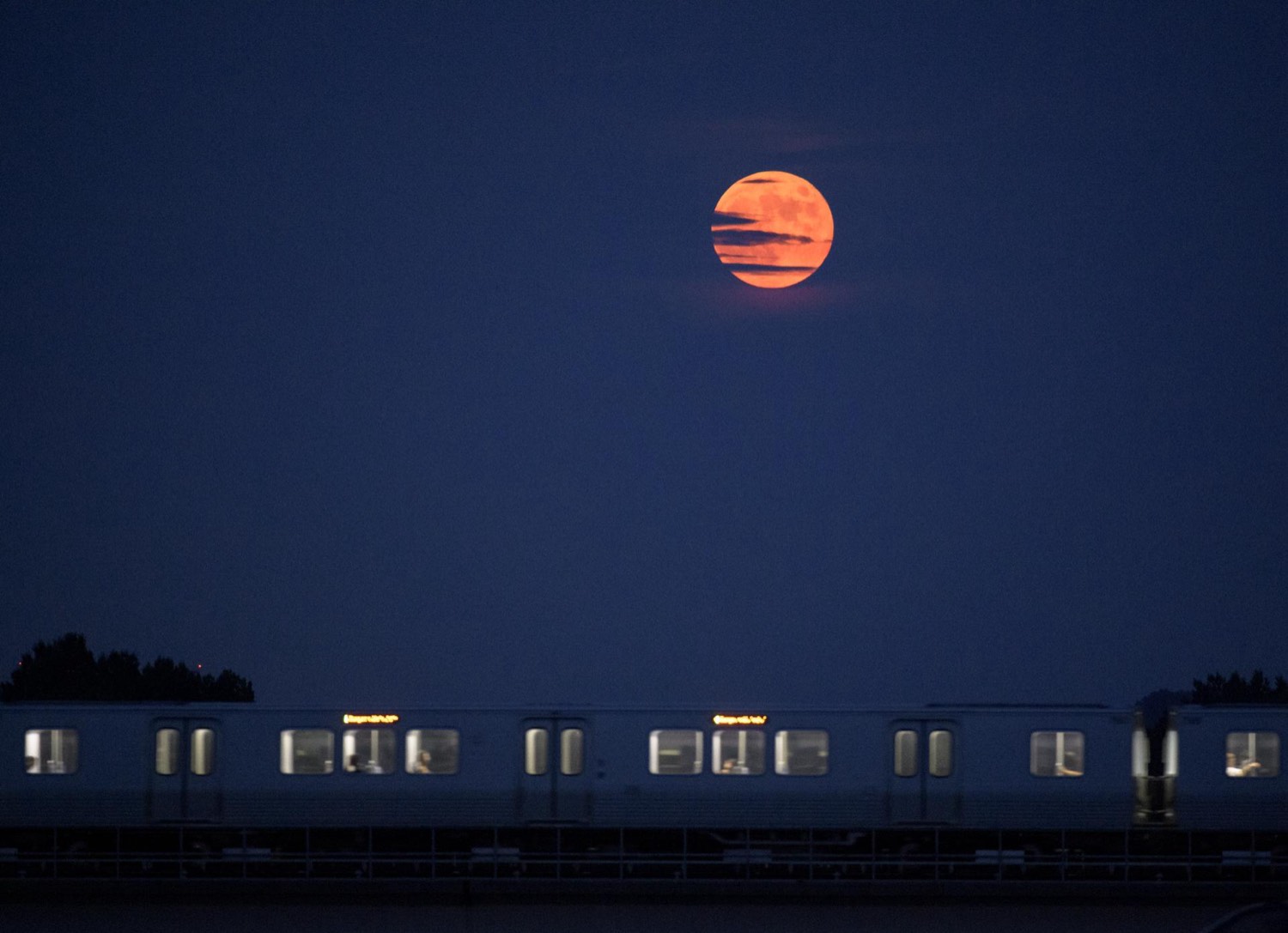
The Moon rises as a Metrorail train crosses the Potomac River near Washington, D.C., on July 16, 2019. Long lenses and nearby objects make the effect even stronger in photos.
Photo: NASA/Bill Ingalls (public domain)
You've seen it. You're driving home and the full Moon is sitting on the horizon, huge and orange, looking close enough to bump into. An hour later it's up in the sky, small and white and ordinary. Nothing about the Moon changed. Something about you did.
It really is the same size
Hold that thought, because it surprises people: the Moon on the horizon is very slightly smaller in angle than the Moon overhead. When it's rising, you're looking at it from the side of Earth, and when it's high you're looking at it from roughly an Earth-radius closer. The difference is about 1.5 percent, the wrong way for the illusion.
Air does change its shape a little. Near the horizon, refraction squeezes the Moon vertically so it looks slightly oval, and the extra atmosphere turns it yellow or orange. Neither of those makes it look bigger.
So what's going on?
Nobody has a single, final answer. That's part of what makes this fun. The ideas that get the most support:
- The flattened-sky idea. We seem to perceive the sky not as a perfect dome but as a flattened bowl, with the horizon feeling farther away than the zenith. If the brain thinks something at the horizon is farther away but it takes up the same angle, it concludes the object must be larger.
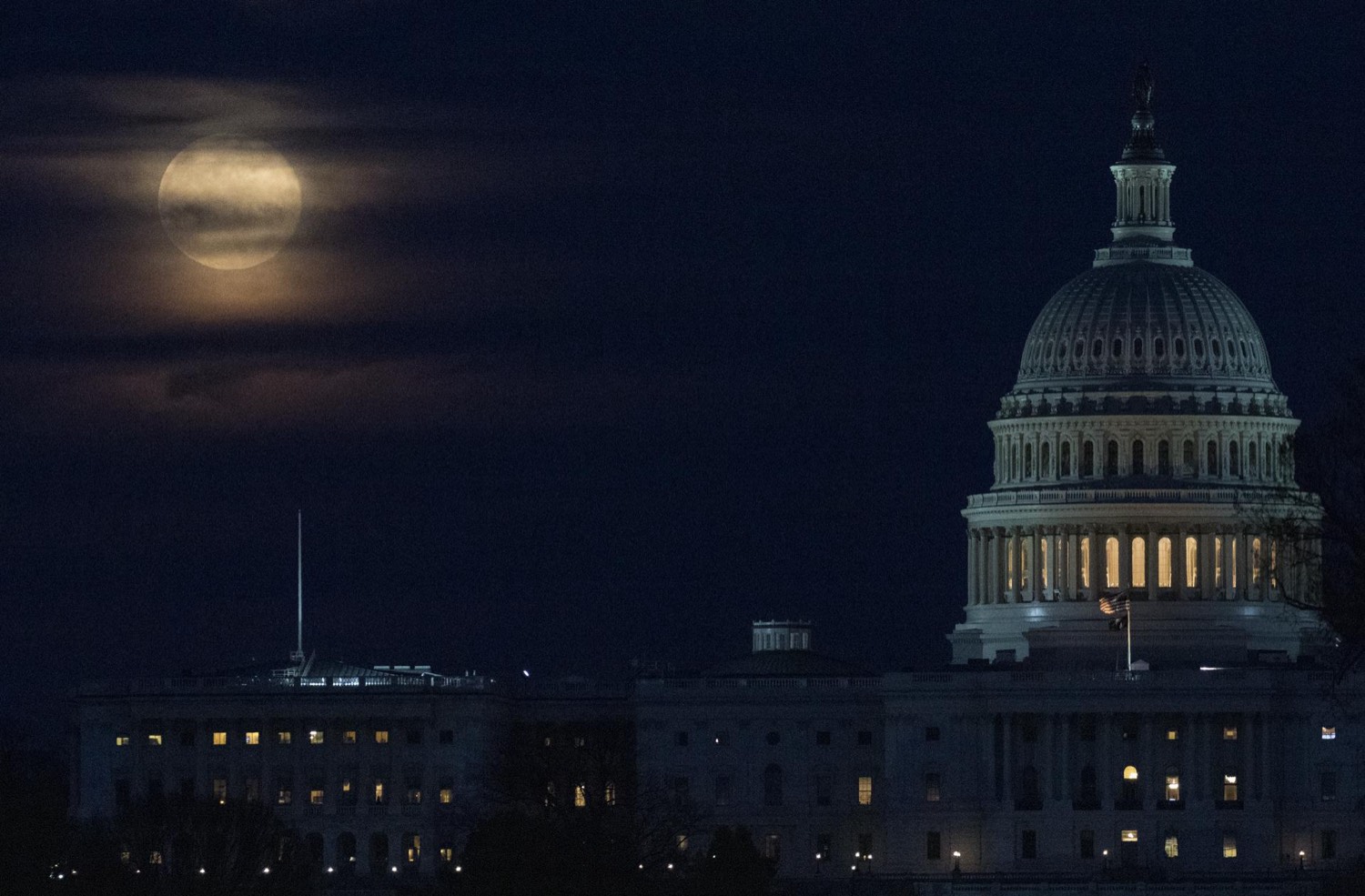
- Size by comparison. At the horizon, the Moon sits next to trees, rooftops and distant hills, things we know are big. Up high, it's alone in a big empty sky. Context changes how big things feel. Psychologists show the same effect with the Ponzo illusion, where two identical lines look different lengths between converging rails.
- Eye and focus effects. Some researchers argue that how our eyes converge and focus when looking at the horizon versus straight up plays a part.
Ptolemy, writing in the second century, already knew it was a perceptual effect. Two thousand years on, the precise recipe is still debated.
Three tests you can do at the curb
- The coin test. Hold a small coin or a pencil eraser at arm's length and compare it with the rising Moon. Repeat a few hours later. The match will be the same.
- The tube test. Roll a sheet of paper into a narrow tube and look at the horizon Moon through it, so you can't see the landscape. Much of the effect vanishes.
- The upside-down test. Bend over and look at the Moon between your legs. It sounds silly, and it is, but many people find the Moon suddenly looks normal-sized. The brain loses its usual sense of the landscape.
Nights this winter when the timing is perfect
The illusion is strongest when the Moon rises in a sky that's still a little bright, so you can see the landscape around it. That happens when the full Moon comes up close to sunset. From San Antonio, three nights line up well:
| Date | Moonrise | Sunset |
|---|---|---|
| Tuesday, Nov 24, 2026 | 5:34 p.m. | 5:36 p.m. |
| Wednesday, Dec 23, 2026 | 5:20 p.m. | 5:41 p.m. |
| Friday, Jan 22, 2027 | 6:32 p.m. | 6:03 p.m. |
The January Moon is also the closest full Moon of 2027, so it really is a little bigger than average, though nowhere near as much as it will look.
Other cities will see the Moon rise within a few minutes of these times on the same dates. A free sky app or almanac will give you the exact moonrise where you live.
Why we keep falling for it
Knowing about an illusion doesn't switch it off. Even researchers who've studied the Moon illusion for decades say it still gets them. That's worth something. On November 24, stand somewhere with a long view to the east, watch the Moon come up behind the landscape, and enjoy being fooled. Then do the coin test, just to keep yourself honest.
Sources and further reading
- Moonrise and sunset times computed with PyEphem for San Antonio, Texas
- Hershenson, M. (ed.), The Moon Illusion (Lawrence Erlbaum, 1989)
- Kaufman, L. & Rock, I. (1962), "The Moon Illusion, I," Science
Calculated times assume the locations named in the story and can shift slightly elsewhere. Found a mistake? Send a correction.